New
You qualify for FREE shipping!
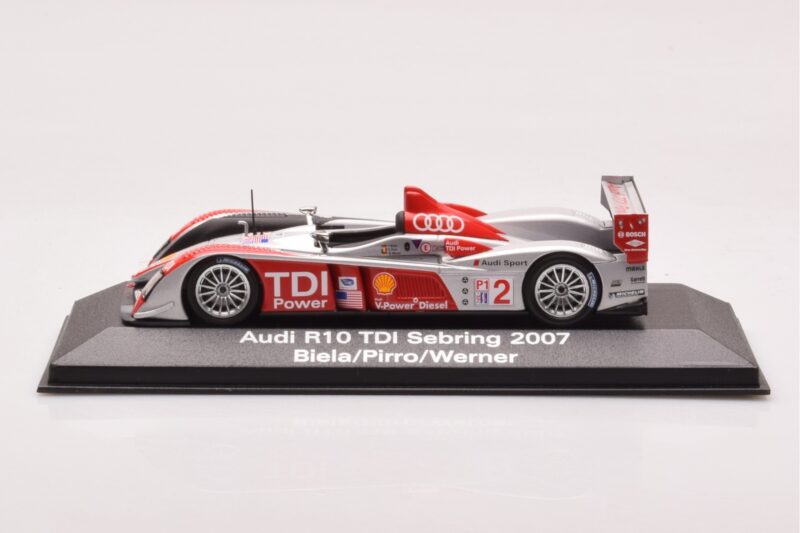
The Audi R10 TDI changed endurance racing from the moment it debuted at Sebring in 2006. A diesel-powered LMP1 prototype winning on American soil — at a race steeped in tradition since 1952 — announced that Audi Sport's engineers had solved the torque and fuel-efficiency equation every other team was still working around. By 2007, the R10 TDI was the confirmed benchmark in top-level sports car racing. This Minichamps Audi R10 TDI 1:43 documents car #2, the specific entry that Frank Biela, Emanuele Pirro, and Marco Werner shared at that year's Sebring 12 Hours — a diecast record of a precise moment in American endurance racing history.
Minichamps approaches motorsport coverage differently than manufacturers focused on single hero pieces. Their 1:43 range documents entire race entries — multiple car numbers from the same event, making it possible to reconstruct historically accurate grid arrangements on a display shelf. For a race like Sebring, where LMP1, LMP2, and GT class entries run simultaneously across twelve hours, this systematic approach has genuine value for those building field-accurate reproductions. The #2 Audi R10 TDI is one piece within a broader program that also covers companion Audi entries and class participants.
At 1:43, this model measures approximately 11 centimeters from nose to tail — compact enough that twenty cars fit across a standard display cabinet shelf with room between them. The zinc alloy diecast construction at this scale produces a model with genuine metal density despite the small footprint. LMP1 prototype bodies present a specific challenge at 1:43: the aerodynamic surfaces, minimal ride height, and enclosed cockpit create shapes where proportion errors read immediately at scale. Minichamps' tooling for the R10 TDI captures the car's identifying proportions — the wide front splitter, the stepped rear bodywork over the engine cover, and the low-slung sidepods that define the R10's silhouette from any viewing angle.
The livery on this piece follows the Audi Sport Team Joest graphics scheme for car #2 at Sebring 2007. Driver names appear tampo-printed directly onto the bodywork. Tampo printing bonds ink permanently to the clear coat layer, producing sharper graphic edges that resist the yellowing and peeling that water-slide decals develop after several years of shelf exposure. The Audi rings, car number, and sponsor markings all sit at their documented positions for this specific race entry — the detail that distinguishes an event-attributed model from a generic livery representation.
Sebring International Raceway carries a particular weight in American motorsport. The former military airfield in central Florida has hosted endurance racing continuously since 1950, making it the oldest surviving sports car race in the United States. The cracked concrete runways and patched infield asphalt punish transmissions, exhaust systems, and aerodynamic components in ways that smooth European circuits cannot replicate — which is why teams preparing for Le Mans traditionally treat a Sebring result as a meaningful mechanical stress test.
The driver lineup on car #2 concentrated serious endurance racing experience into three names. Frank Biela, the German driver from Neuss, won Le Mans five times in Audi machinery. Emanuele Pirro, the Italian former Formula 1 driver who became the cornerstone of Audi's endurance program, also claimed five Le Mans victories. Together they formed the core of Audi Sport's dominant prototype operation through the 2000s. Marco Werner brought further Audi LMP experience to the partnership, completing a crew with specific preparation for Florida's heat and unforgiving surface conditions. When this Minichamps Audi R10 Biela Pirro Werner Sebring 1:43 piece sits in a display, the crew attribution is not decoration — it anchors the model to a specific racing act by three drivers with collectively fifteen Le Mans wins between them.
The R10 TDI ran a 5.5-liter twin-turbocharged V12 diesel engine producing approximately 650 horsepower. The fuel economy advantage over competing petrol-powered prototypes translated directly to fewer pit stops over twelve hours — fewer stops means fewer opportunities for mechanical failure during service and fewer seconds lost stationary. Audi had built a car that won through physics as much as outright pace, and Sebring's twelve-hour format rewarded exactly this approach. The model documents a specific expression of that program: not a generically liveried R10, but the #2 car with its precise crew recorded on the bodywork.
The choice of 1:43 for endurance racing documentation is not arbitrary. At this scale, a complete Sebring LMP1 field occupies roughly two feet of shelf space. Twenty, thirty, sometimes forty-plus cars run simultaneously across multiple classes at Sebring — the only practical format for documenting that breadth is 1:43. For US hobbyists following IMSA WeatherTech or the broader ACO endurance calendar, compact scale is where comprehensive display becomes achievable without a dedicated room.
The Audi R10 TDI Sebring piece also travels well within a wider Audi motorsport chronology. The R10's successors — the R15 TDI, then the hybrid R18 e-tron quattro series — appear in Minichamps' 1:43 range, enabling a continuous Audi Le Mans prototype timeline across multiple generations. Each car in such a lineup tells a distinct story: the R10 represented the diesel revolution, the R18 added hybrid recovery. Placing the Sebring 2007 piece alongside other Audi LMP entries creates a manufacturer chronology with visual and material consistency throughout.
Those building IMSA-specific American endurance displays can extend further — adding Sebring entries from different eras alongside this 2007 piece: Porsche 962 appearances from the 1980s, Corvette GTP seasons, modern GT class entries. At roughly eleven centimeters per car, the scale makes breadth-first collecting viable in a way that 1:18 simply cannot support for race field documentation. This Audi LMP1 prototype scale replica sits naturally as an anchor for any IMSA or sports car endurance display covering the 2000s decade.
For the R10 TDI at Sebring 2007 at 1:43, the competitive landscape for serious buyers narrows to two main producers: Minichamps and Spark. The comparison matters for purchase decisions because the approaches diverge meaningfully. Spark uses sealed polyurethane resin at 1:43, which produces sharper aerodynamic edges and finer surface transitions than zinc alloy diecast casting. Spark also runs smaller production quantities at higher prices. Minichamps' diecast construction offers genuine metal weight and durability, with broader distribution that makes the model more accessible. Neither approach is unconditionally superior — Spark's resin precision suits display-first buyers who rarely handle their pieces, while Minichamps' metal construction suits those who examine and reposition models regularly.
IXO provides a third option at the entry-level tier, covering 1:43 race cars with simplified graphic execution and slightly looser tolerances. For the Audi R10 TDI specifically, Minichamps' mid-tier positioning represents a considered balance between Spark's resin detail and IXO's accessible diecast pricing.
Within Minichamps' own catalog, the R10 TDI Sebring entry sits within a broader Audi Sport documentation program spanning multiple Le Mans and Sebring entries across the R8, R10, R15, and R18 generations. Committing to Minichamps' systematic coverage ensures visual consistency across the shelf — same scale, comparable surface quality, matching graphic execution standard across seasons and events. For Sebring devotees and Audi endurance aficionados alike, that internal consistency is the defining advantage of building within one manufacturer's long-running documentation program rather than mixing producers.