New
We'll notify you once when this item is available. No spam.
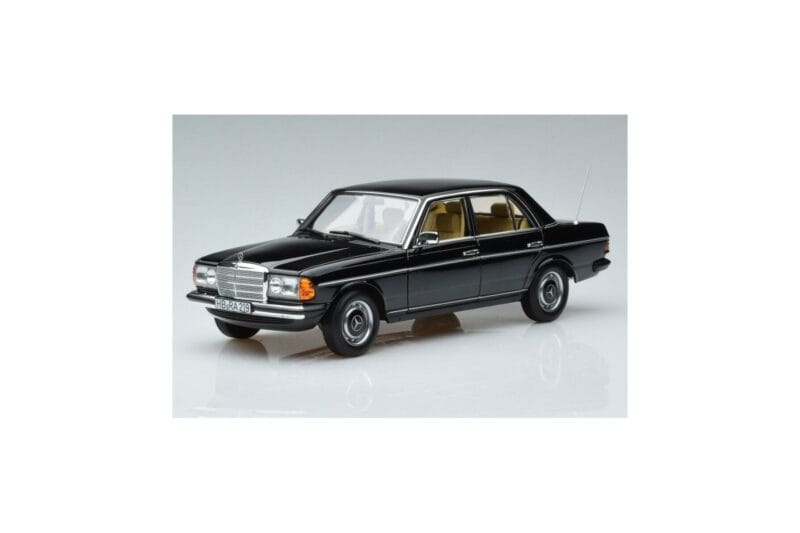
Few sedans from the 1980s have aged as gracefully in collector regard as the Mercedes-Benz W123. Produced from 1976 through 1985, the W123 230E represents the generation of Stuttgart engineering that built the marque's modern reputation — overbuilt by contemporary standards, designed for longevity measured in decades rather than warranty periods, and still found in daily use on three continents. Norev's limited edition 1:18 diecast model of the 1980 230E brings this Mercedes W123 into die-cast metal form, a format that suits the car's solid, substantive character precisely. For collectors who track European sedans of genuine significance, this is the anchor piece that explains why the W123 commands consistent respect across enthusiast communities worldwide.
Norev occupies a well-defined position in the 1:18 diecast landscape: a French manufacturer with decades of European automotive coverage, producing metal-bodied models at a price point that makes systematic collecting practical. The W123 230E is exactly the type of subject where Norev's approach works to maximum advantage. The car's design language — crisp Pininfarina-influenced creases, flush glass, minimal brightwork — translates cleanly to die-cast zinc construction without demanding the hand-finished resin treatment that compound-curve Italian sports cars require.
Opening doors, hood, and trunk are standard on Norev's 1:18 tier, and on the W123 these features pay off in specific ways. The interior reproduces the 230E's characteristically upright seating position, the wide-set dashboard with its analog instrumentation cluster, and the deep door cards that gave the original its vault-like solidity. Lift the hood and the M102 2.3-liter four-cylinder — the engine code that gives the 230E its designation — sits correctly oriented in the engine bay with intake and exhaust manifold detail visible at arm's length. At roughly 25 centimeters nose to tail, the 1:18 format provides enough physical presence to appreciate the W123's proportions: the long hood relative to passenger compartment, the near-vertical trunk lid, the roofline that sits higher than any contemporary sedan would tolerate.
The limited edition designation on this Norev release typically signals a specific color or specification variant produced in smaller quantities than the standard catalog run. For the W123, colors like Astralsilber Metallic, Signalrot, and Polaris Silber carry period-correct authenticity — these were the factory paint codes that appeared on the original order forms at Stuttgart dealerships in 1980. A correctly matched color transforms a solid reproduction into a document of how these cars actually appeared on the road.
Mercedes-Benz introduced the W123 at the 1975 Geneva Motor Show as the direct successor to the W114/W115 series — known colloquially as the