TL;DR: Building a model car collection comes down to five decisions: pick your scale first, then choose between diecast and resin, find a brand tier that fits your wallet, set a realistic monthly spend, and anchor everything with a theme. Get those right and you won’t end up with a shelf full of regrets.
Decision Criteria Overview Table
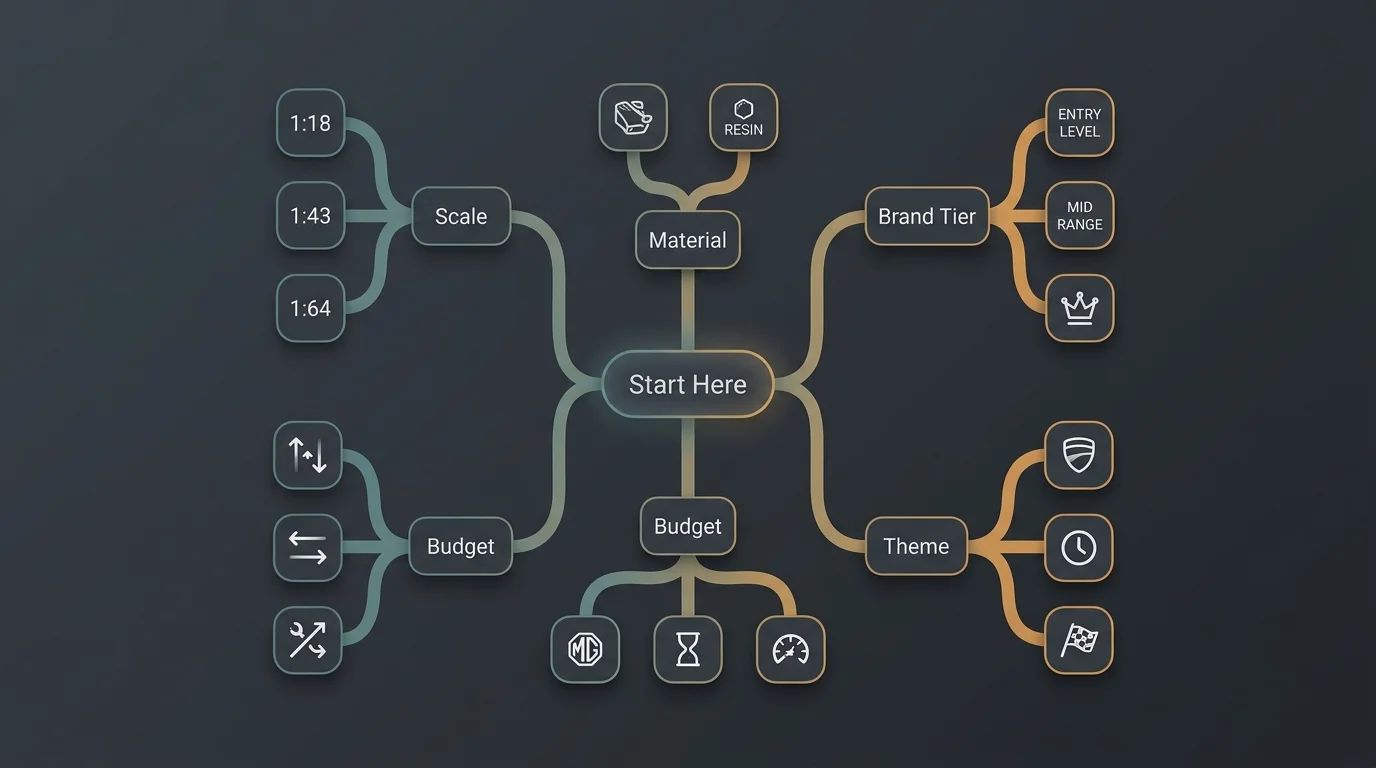
Before you read another word, here’s the quick reference. Every new collector faces the same five choices, and they’re all connected. Your scale determines how much shelf space you’ll need. Your material preference affects price. Your brand tier shapes quality expectations. And your theme keeps the whole thing from turning into an expensive mess.
| Decision | Key Question | Beginner-Friendly Pick | Why It Matters |
|---|---|---|---|
| Scale | How much space do I have? | 1:43 for compact, 1:18 for detail | Locks in display size and price range |
| Material | Do I want to handle my models? | Diecast (opening parts, durable) | Defines the collecting experience |
| Brand tier | What’s my quality baseline? | Mid-range (Norev, Solido, IXO) | Sets expectations and resale potential |
| Budget | What can I spend monthly? | EUR 50-100/month | Prevents impulse buying and regret |
| Theme | What story does my collection tell? | Single marque or era | Creates focus and visual cohesion |
Does that seem like a lot to think about? It’s actually simpler than it looks. We’ve handled thousands of models over the years, and the collectors who enjoy the hobby most are the ones who made these five choices intentionally rather than stumbling into them. Let’s walk through each one.
How to Choose the Right Scale
Scale comes first. It’s the single most important decision you’ll make, full stop. Why? Because it determines everything else: how much each model costs, how much shelf space you’ll need, which brands are even available to you, and whether your display will look intentional or accidental twelve months from now. We’ve seen too many beginners grab whatever catches their eye and end up with a mismatched shelf that doesn’t look or feel like a collection.
The Most Popular Collector Scales
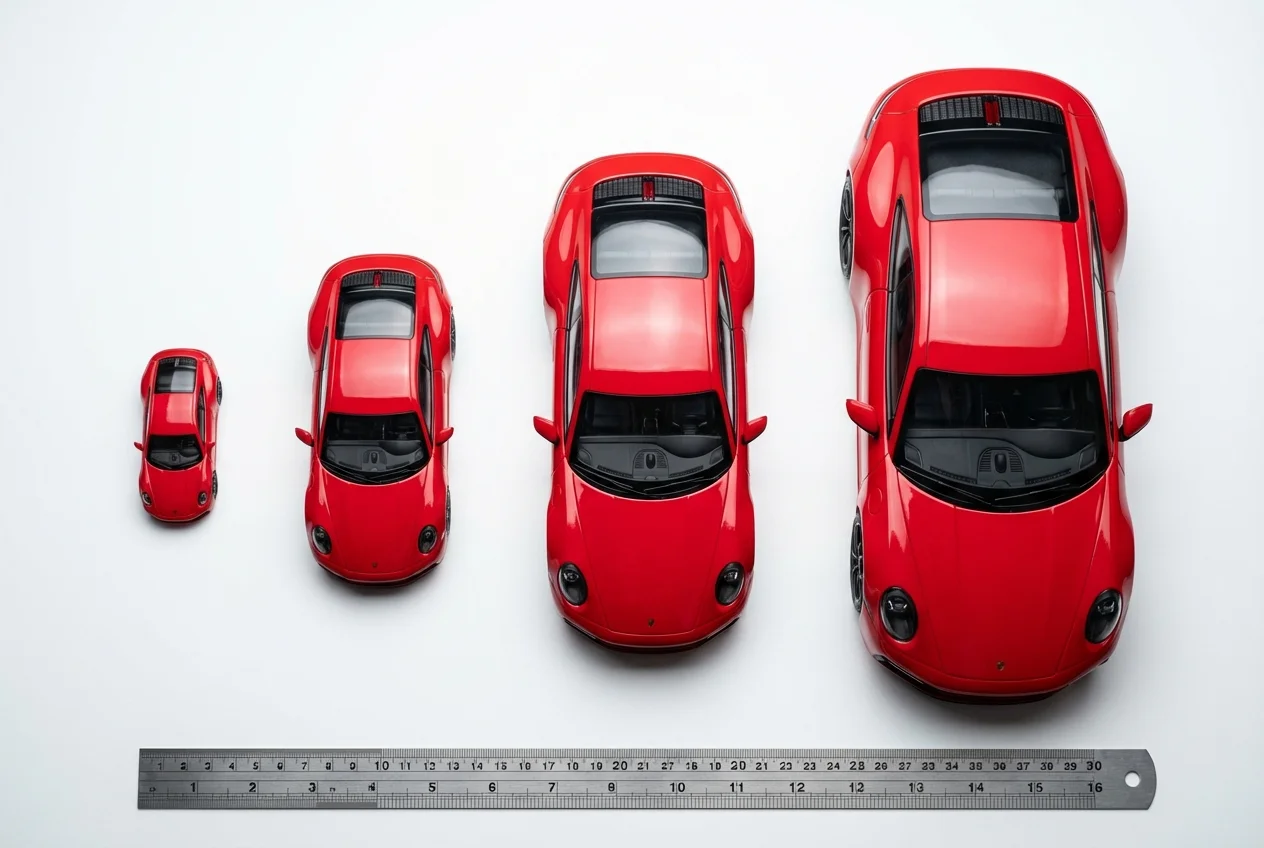
Four scales dominate the hobby, and each serves a different type of collector. A 1:18 model measures roughly 10 to 12 inches long (AUTOBarn Models), which gives manufacturers room for serious detail: opening doors, textured interiors, even engine bay replicas. It’s the scale most serious collectors gravitate toward.
Then there’s 1:43, approximately 4 inches long (Model Cars Houston), the European collector’s bread and butter. Motorsport fans particularly love this scale because the selection of racing liveries is massive. You can fit dozens of 1:43 models where a handful of 1:18s would live.
What about 1:64 and 1:12? They sit at opposite ends of the spectrum. The 1:64 scale is pocket-sized, perfect for building large themed collections without breaking the bank. Meanwhile, 1:12 is museum territory, with models that can measure 35 to 40 centimetres and command prices that reflect their size.
Scale and Display Space Requirements
Here’s something most guides skip entirely. How much shelf space will you actually need? A single 1:18 model takes up roughly 30 centimetres of width, so a standard 80 cm shelf holds two comfortably, maybe three if you’re okay with them being snug. With 1:43, that same shelf fits eight to ten models with breathing room.
From our experience, beginners consistently underestimate this. They buy a gorgeous display case, fill it in three months, and then face an awkward decision: stop buying, or invest in more furniture. Think about your available space before you commit to a scale. Obvious? Sure. But you’d be surprised how often it’s overlooked.
Scale Mixing: When It Works and When It Doesn’t
Can you mix scales? Absolutely. Should you? It depends. A shelf with one 1:18 Porsche next to five 1:43 Formula 1 cars can look intentional if they’re grouped separately. But a random mix of 1:18, 1:43, and 1:64 models scattered together without any grouping logic tends to look chaotic rather than curated, and that can be discouraging when you’re trying to build something you’re proud of.
In our opinion, the safest approach for beginners is to pick one primary scale and stick with it for your first ten to fifteen models. Once you’ve developed an eye for display composition, mixing becomes easier. Your mileage may vary, of course, and some collectors pull off mixed-scale displays beautifully. It’s just harder when you’re starting out.
How to Choose the Right Material
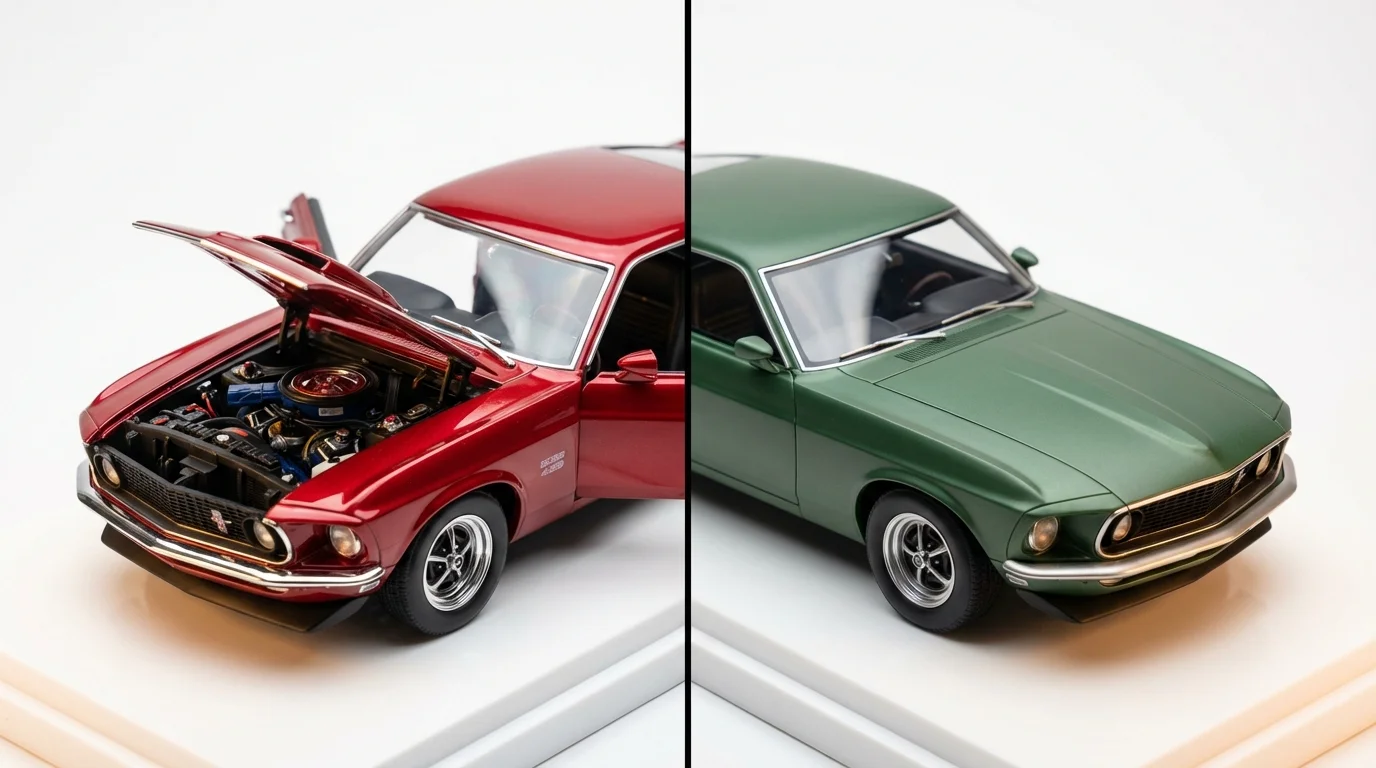
Material choice shapes the entire collecting experience. Two options: diecast (metal alloy construction, typically with opening parts) and resin (polyurethane resin, sealed construction, no opening features). It’s also the decision that confuses beginners most, because neither is “better.” They serve different collectors with different priorities and different ideas about what a model should feel like in their hands. For a deeper breakdown, check out our diecast vs resin material guide.
Diecast for Hands-On Collectors
Want to open the doors, lift the hood, and inspect the engine bay? Diecast. That satisfying weight in your hand, the click of a tiny door hinge: it’s part of what makes collecting tactile and fun. Diecast models are also more forgiving of handling, which matters when you’re still learning how to move models without damaging them.
We’ve noticed that most beginners start with diecast instinctively. There’s something about picking up a model and feeling its heft that immediately validates the purchase. “This isn’t a toy,” your brain says. “This is a proper miniature.” And honestly, that feeling doesn’t get old.
Resin for Display-Focused Collectors
Resin is different. Completely. They’re sealed (no opening parts), lighter in hand, and produced in smaller quantities. What do you get in return? Razor-sharp body lines and proportions that diecast sometimes can’t match, because the sealed construction allows tighter tolerances.
Don’t make the mistake of thinking resin means unfinished or plain. Resin models are fully painted, often with glossy finishes that rival the best diecast out there. They’re display pieces through and through, meant to be admired on a shelf rather than handled regularly. Limited production runs (typically a few hundred to a few thousand pieces) also mean better resale potential down the road.
Starting with Diecast and Adding Resin Later
Here’s what we tell most beginners. Start with diecast. Get comfortable handling models, learn what quality looks like, develop your eye for proportions and paint. Then, when you’re ready to add a centrepiece that you won’t be touching often, pick up a resin model. This progression feels natural and avoids the frustration of buying a sealed resin piece before you appreciate what makes it special.
How to Choose Your First Brand
Brand selection is where many new collectors get lost, and it’s not hard to see why. Dozens of manufacturers, wildly different quality levels, confusing price points. The trick is matching brand tier to your goals rather than chasing whatever name comes up first in a search. Our brand tier ranking covers the full picture if you want the deep version.
Matching Brand Tier to Your Goals
Broadly speaking, manufacturers fall into tiers. Entry-level brands like Maisto, Bburago, and Welly offer affordable models with decent detail (Weye Model Cars). You won’t get micro-level engine details or perfectly aligned panel gaps, but you’ll get a solid representation of the car at prices that won’t sting.
Mid-range brands, including Norev, Solido, and IXO, step things up considerably. Better paint, more accurate proportions, improved opening features. In our years handling these models, the mid-range tier consistently delivers the best value for money. You’re paying more, but the quality jump from entry-level is dramatic.
Premium brands occupy the top shelf. CMC and BBR produce museum-quality diecast and resin pieces respectively, with hand-assembled components, photoetched parts, and leather-like interiors (Weye Model Cars). AUTOart uses composite construction (metal body paired with detailed resin and plastic interiors), which puts it in its own category. Stunning work across the board? Necessary for a beginner? Probably not, unless you have a very specific model in mind and the funds to match.
Evaluating Quality When You’re New
How do you judge model quality when you’ve never held one before? Focus on four things: panel gaps (are they even and consistent?), paint finish (any orange peel, dust specks, or misaligned masking?), weight (does it feel substantial or hollow?), and proportions (does it look like the real car, or does something feel “off”?). Don’t worry about perfection on day one. Your eye develops quickly once you start comparing models side by side.
Can you trust online reviews? Sometimes. Collector forums and dedicated YouTube channels tend to be more honest than brand-sponsored content. When in doubt, look for reviews that show close-up photos rather than stock images.
Setting Your Budget
Let’s talk money. Everyone wants this question answered. Few guides do it honestly. How much does this hobby actually cost, and where exactly does the money go?
Budget Allocation: Models vs Display vs Accessories
Your budget shouldn’t go entirely toward models. A rough split that works well: 70% on models, 20% on display (cases, shelving, lighting), and 10% on accessories (cleaning supplies, storage materials). Why? Because a EUR 200 model looks terrible on a dusty bookshelf, and a EUR 50 model looks surprisingly good in a proper glass case with LED lighting.
What does a realistic monthly budget look like? It depends entirely on your chosen scale and tier. In 1:43 at mid-range, EUR 28 to 92 per model (Model Cars Houston) means you could add one or two pieces monthly on a EUR 100 budget. In 1:18 diecast, EUR 138 to 276 per model (Model Cars Houston) means one model every month or two at the same budget level. And if you’re eyeing 1:12, prices of EUR 276 to 644 per model (Model Cars Houston) make it a slower, more deliberate pursuit.
The True Cost Beyond the Model
Nobody tells you about the hidden costs until you’ve already started. Display cases range from EUR 40 for a basic glass cabinet to EUR 300 or more for custom-built units. UV-protective acrylic covers for individual models run EUR 10 to 25 each. Microfibre cloths, compressed air cans, silica gel packets for humidity control, soft gloves for handling: these things add up.
In our experience, budgeting about EUR 150 for initial display infrastructure (before buying a single model) saves you from the “nice models, terrible presentation” trap that catches so many beginners. Is it glamorous spending? No. But your collection will look twice as good from day one.
Building a Theme for Your Collection
A theme transforms a random group of models into an actual collection. Without one, you’ll find yourself buying whatever’s on sale, and six months later you’ll have a shelf that tells no story at all. Does every model need to connect to every other? Not necessarily, but having a thread that ties most of them together makes the whole thing more satisfying.
Single Marque vs Multi-Marque Collections
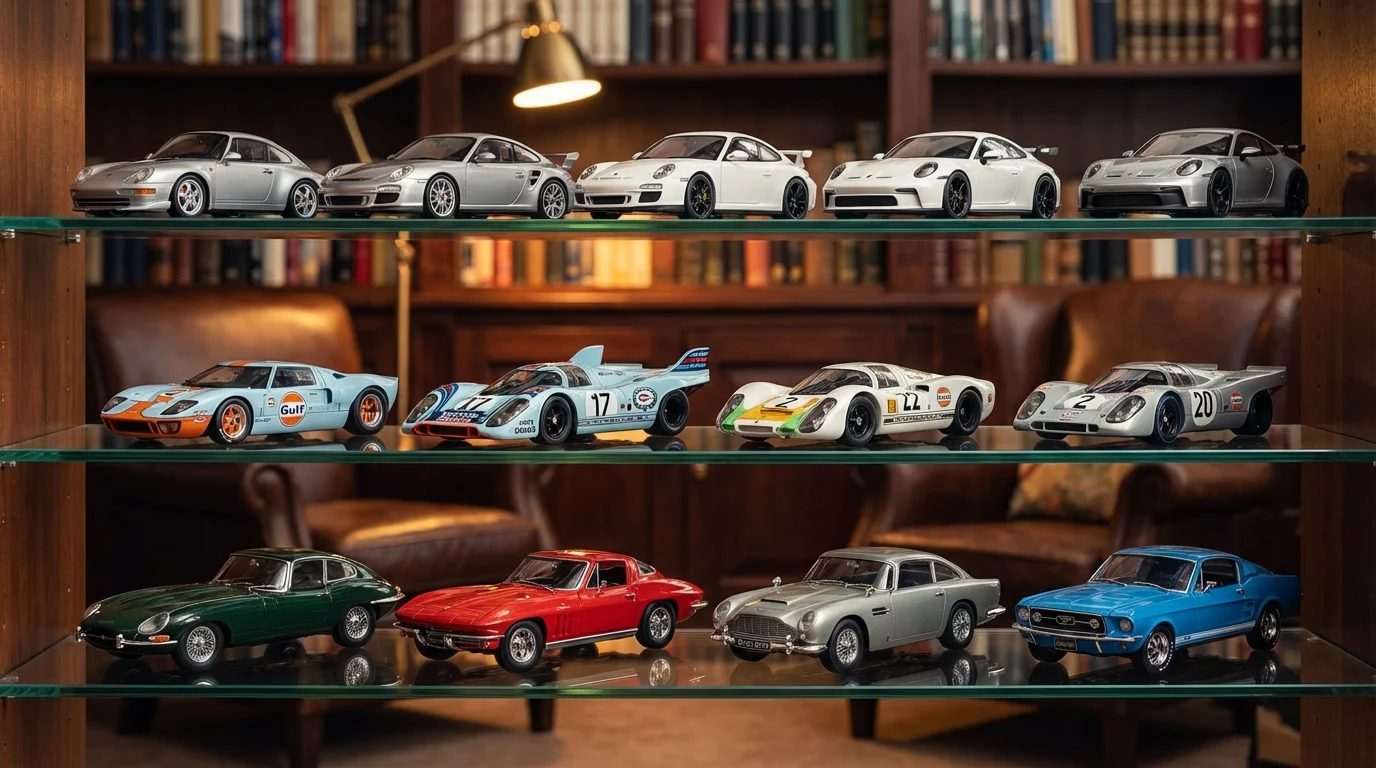
The simplest theme: pick one car brand and build around it. A Porsche-only collection, a Ferrari-only collection, or a Mercedes-Benz-only collection instantly creates visual cohesion. You can explore different eras, different body styles, different model scales within that marque, and it still looks intentional.
Multi-marque themes work too, but they need a stronger organizing principle. “German sports cars from the 1990s” is a theme. “Cars I think look cool” is not. From our experience, the tighter your theme, the more pleasure you’ll get from finding that next perfect addition.
Era-Based and Motorsport Themes
Motorsport themes are wildly popular, and for good reason. Le Mans prototypes, Formula 1 liveries, Group B rally cars, classic DTM: each of these gives you a focused window into automotive history with no shortage of models to collect. The 1:43 scale particularly shines here because the selection of racing models is enormous.
Era-based themes offer similar focus. Classic cars from the 1960s and 1970s, the supercar boom of the 1980s, modern hypercars: whatever period fascinates you, there are models to match. We’ve seen collectors build stunning displays around a single decade, and the result always tells a richer story than a random assortment.
How to Evolve Your Theme Over Time
Your theme doesn’t need to be permanent. Many collectors start broad, something like “European sports cars,” and narrow their focus over time as they discover what truly excites them. That’s perfectly fine. Themes evolve. The real point of having one at all is giving yourself a filter for purchase decisions, a simple gut check when you’re standing in front of a model you didn’t plan to buy. “Does this fit?” If the answer is no, walking away becomes much easier.
Common Mistakes New Collectors Make
Same traps, different beginners. We’ve watched it happen for years. None of these mistakes are fatal (you can always course-correct), but they’re all avoidable if you know what to watch for. For more on protecting your investment once you’ve started, see our care and display guide.
Buying Without a Focus
This is the most common mistake by far. You see a great deal on a 1:18 Lamborghini, then a nice 1:43 rally car, then a 1:64 vintage truck. Six months later you’ve spent EUR 500 and your “collection” looks like a jumble sale. Sound familiar? Having a theme (even a loose one) prevents this entirely.
Ignoring Storage and Display Conditions
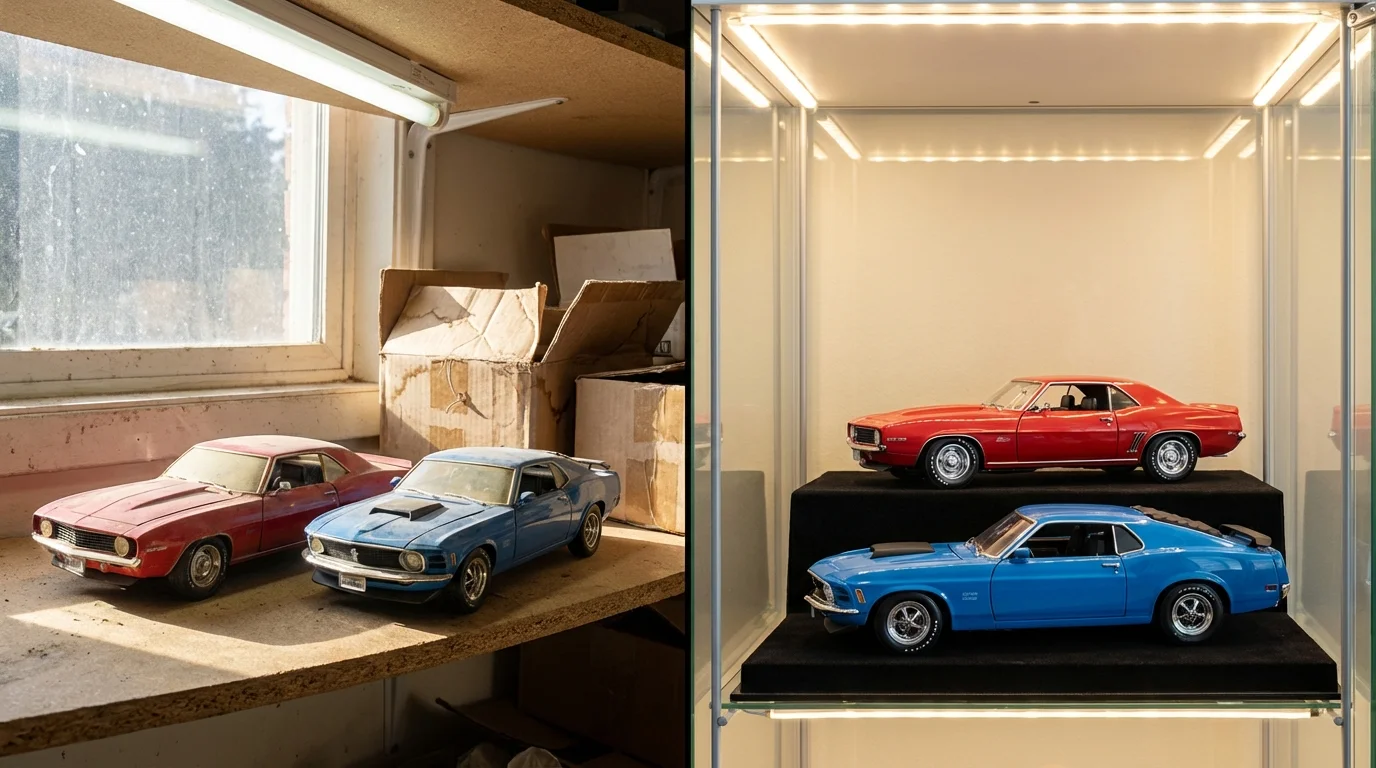
Dust is a model’s worst enemy, followed closely by direct sunlight. UV exposure fades paint over time, and dust particles can scratch surfaces when you try to clean them off. A display case with glass doors isn’t a luxury; it’s basic protection. And placing your shelf away from windows takes zero effort but makes a real difference over years of collecting.
Overpaying on the Secondary Market
When a model sells out at retail, its secondary market price can spike dramatically. New collectors often panic-buy at inflated prices, only to find the same model restocked or a newer, better version released months later. Patience pays. It’s genuinely one of the most underrated skills in this hobby. Unless a model is truly limited edition with confirmed production numbers, rushing rarely pays off.
Recommended Starting Points by Collector Type
Not every collector is the same, so here are tailored recommendations based on four common profiles. These aren’t the only paths, but they’re solid starting points we’d feel comfortable recommending to anyone.
The Budget Explorer
You want to try the hobby without a major commitment. Start with 1:43 scale diecast from brands like Solido or IXO. Models in this range typically cost EUR 28 to 92 (Model Cars Houston), so you can build a small collection of four or five pieces without significant financial risk. Pick a theme (marque or era) and give yourself a few months before deciding whether to continue.
The Detail Enthusiast
Quality matters more than quantity to you. Go straight to 1:18 diecast from mid-range brands like Norev. You’ll pay more per model, but the opening features, interior detail, and overall presence are on a different level. One exceptional 1:18 Norev sitting on a well-lit shelf behind glass can genuinely feel more satisfying than ten mediocre models crammed together on an open bookshelf.
The Motorsport Fan
You’re driven by racing history, not road cars. The 1:43 scale is your sweet spot because the range of available motorsport liveries is unmatched. IXO, Minichamps, and Spark cover everything from Le Mans to WRC to Formula 1. Build around a specific series or era, and you’ll have a collection that doubles as a visual timeline of racing history, the kind of display that sparks conversations with anyone who walks past your shelf.
The Investment-Minded Collector
You care about potential resale value alongside the enjoyment. Look at limited-edition resin models from brands like GT Spirit, OttOmobile, or BBR. Small production runs and strong collector demand tend to support values over time. Keep models in mint condition with original packaging, and you’ll maximize future options. For more on this angle, read about investment and resale value in scale models.
FAQ
How much should I spend on my first model?
Somewhere between EUR 30 and EUR 80 is a comfortable range for a first purchase. That puts you in mid-range 1:43 or entry-level 1:18 territory, where quality is good enough to give you a genuine taste of the hobby without committing serious money. If you’re unsure, start at the lower end and work up as your preferences become clearer.
Is model car collecting a good investment?
It can be, but it shouldn’t be your primary motivation. Limited-edition models from established brands do tend to hold or increase in value, particularly resin pieces with documented production runs. That said, the global diecast model car market is valued at approximately EUR 4.02 billion with a projected CAGR of 5.2% (Business Research Insights), which suggests the hobby is growing steadily rather than shrinking. Collect what you love first; any financial appreciation is a bonus.
Where should I buy model cars?
Specialized model car retailers (both online and physical) are your safest bet, because they handle models properly during shipping and can verify authenticity. Marketplace platforms work for finding discontinued models, but verify seller ratings carefully. Collector forums and events are also excellent for finding specific pieces and getting fair prices from fellow enthusiasts.
How many models make a collection?
There’s no magic number. Two will do. Seriously. Two models with a connecting theme can be the start of a collection. We’ve seen collectors with hundreds of pieces, and we’ve seen collectors with just a dozen carefully chosen models who consider their set complete. It’s about intention, not volume. If you’ve chosen your models deliberately around a theme, you’ve got a collection.
Should I keep model cars in their boxes?
It depends on your goals. If resale value matters to you, keeping the original box and any documentation is important, because mint-in-box models consistently command higher prices. But keeping models permanently boxed defeats the purpose of a visual collection. A practical compromise: display the model and store the box somewhere safe and dry. You get the visual enjoyment while preserving the packaging for potential future sale.
Conclusion
Starting a model car collection doesn’t need to be overwhelming. Five decisions. That’s it. Lock in your scale, choose your material, find a brand tier that fits your budget, set a realistic spend limit, and pick a theme. Those five decisions create the foundation that everything else builds on, and you don’t need to get them all perfect on day one. What matters is starting with intention rather than impulse.
The hobby is big enough (Europe alone accounts for 30 to 36% of the global market share, per Business Research Insights) that whatever niche excites you, there are models waiting to fill it. Take your time, enjoy the process of discovering what you love, and remember that the best collection is the one you actually enjoy looking at every day.