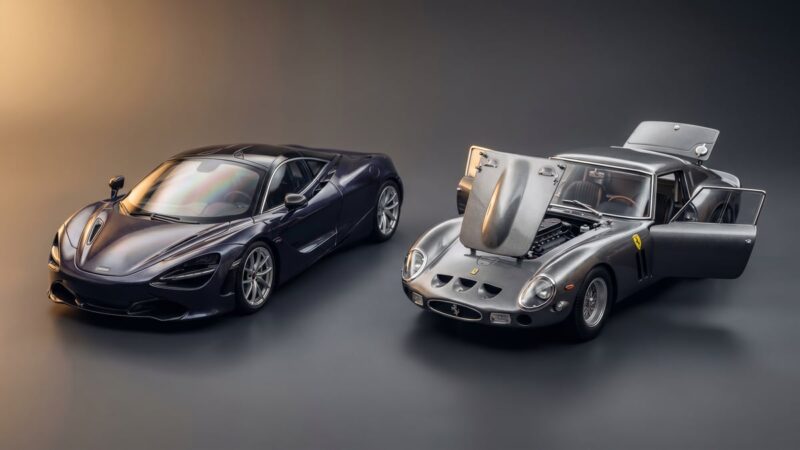
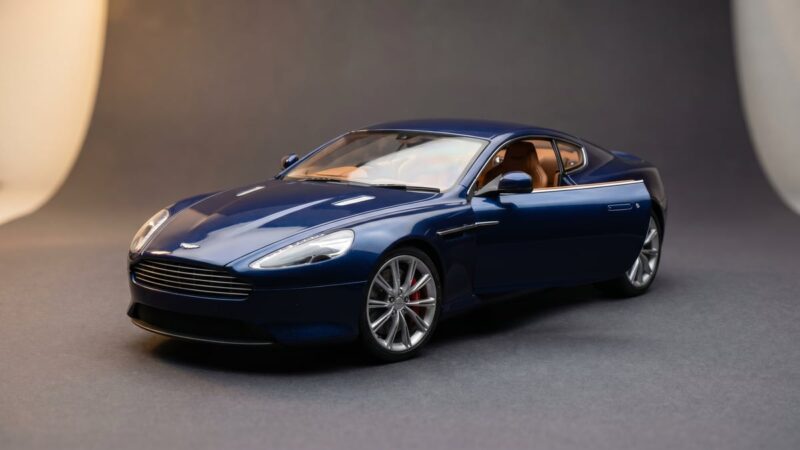
Neither Minichamps nor AUTOart is simply the better choice. They are two premium 1:18 manufacturers that trade different strengths, and the right pick depends on what you value — and, just as importantly, on which AUTOart era you are buying. Minichamps is a German die-cast house founded as Paul’s Model Art in 1990, built on zamak metal bodies, broad official licensing from car brands including Mercedes-Benz, Audi, Porsche, Volkswagen, Opel and BMW, and a deep range across 1:18, 1:43 and 1:64. AUTOart is a Hong Kong manufacturer established in 1998 and prized for fine functional detail, down to working dampers on the doors, hood and trunk.
The single fact most comparisons miss is material. Minichamps’ core line is die-cast metal, while AUTOart switched from die-cast to composite, a construction that combines ABS plastic with die-cast elements, so its earlier and later models genuinely differ in feel — and you must check which one a given model uses. The two are also historically entwined through UT Models and Gateway. In short: for openable, licensed die-cast across the widest range, Minichamps fits; for the finest opening-part detail in 1:18, AUTOart fits. Both can hold value through numbered runs and the slow attrition of surviving examples, but neither guarantees it. The rest of this guide turns that into a decision you can make before you buy.
Who makes each, and how the two are related

These are two distinct manufacturers with overlapping histories. Minichamps is German and AUTOart is from Hong Kong, yet their corporate family trees cross in a way that surprises most collectors.
Minichamps: Paul’s Model Art of Aachen

Minichamps is a die-cast model car manufacturer founded as Paul’s Model Art GmbH in 1990 in Aachen, Germany, and is best known for its 1:18, 1:43 and 1:64 scale models. It grew out of the Danhausen trade business, where the Lang brothers distributed 1:43 models by mail order and published the Danhausen World Model Car Book annually from 1971 to 1993, the final edition listing 15,000 models across 350 pages. The first Paul’s Model Art die-cast car appeared in 1990: a 1:43 model of the Audi V8 driven by Hans-Joachim Stuck, winner of the 1990 German Touring Car Championship. The company was officially named Minichamps GmbH in 1996, and by 1995 it was already producing more than 110 different castings in several hundred racing liveries across three scales.
AUTOart: a Hong Kong detail specialist
AUTOart is a Hong Kong-based scale model car line established in 1998, manufactured by Gateway Autoart Ltd and sold by AA Collection Ltd. Its range has been organised over time into the Millennium, Performance and Signature series, with scales spanning 1:64 to 1:12. Where Minichamps built its name on licensed breadth, AUTOart built its reputation on the depth of detail packed into a smaller, car-focused catalogue.
The shared family tree: UT Models and Gateway
The two manufacturers are more closely linked than their separate logos suggest. UT Models was originally a German company with die-cast cars made in China, associated with Paul’s Model Art (Minichamps); its 1:18 line was introduced in the 1990s in collaboration with Kelvin Kwan of Unique Toys, Hong Kong. Lines formerly associated with AUTOart include Gateway, Gate and UT Models — and in 2004 Paul’s Model Art initiated a lawsuit in Hong Kong against UT Models and Gateway over distribution rights in Germany. So the entwined history is not trivia: it is why a collector encounters the same names across both camps.
Material and construction: die-cast metal vs composite
This is the single biggest practical difference between the two, and the one most forum threads get wrong. Minichamps’ core line is die-cast metal; AUTOart switched from die-cast to composite. Knowing which you are holding matters more than any spec sheet.
Minichamps: die-cast zamak
Die casting forces molten metal under high pressure into a cavity formed by two hardened tool-steel dies; the metal used in models is most commonly zamak, a zinc-based alloy with aluminium, magnesium and copper, which gives die-cast models their characteristic heft, good surface finish and dimensional consistency. A die-cast model already combines several separately tooled materials — the metal body plus ABS plastic accessories, PVC rubber-type tyres and clear plastic windows — with each material requiring its own steel tools over a tooling process of several months. Those steel tools demand high capital, which structurally favours larger production runs. Minichamps’ core production is die-cast zamak, though the brand index describes its output as die-cast zamak or resin, so the material of any individual release is still worth verifying per product line.
AUTOart: from die-cast to composite
AUTOart switched from die-cast to composite construction, combining ABS plastic with die-cast elements: older AUTOart releases are die-cast while later ones are composite. Composite is a distinct, named construction category, not a variant of pure die-cast — it makes ABS plastic the primary body material combined with die-cast elements, whereas a conventional die-cast model uses ABS only for accessories alongside a metal body. That is why a composite AUTOart can carry the same crisp detail at less weight than a full-metal die-cast model.
How to tell which AUTOart era you are holding
Because AUTOart spans both constructions, you must check which one a given model uses rather than assume a single material across the brand. Earlier releases are die-cast metal and feel noticeably heavier in the hand; later releases are composite and feel lighter for their size. The safest check is the construction stated for that specific model line, not the brand name. If you want to see the current detailed cars, browse AUTOart detailed 1:18 models and judge the construction and finish for yourself.
Detail, opening parts and range
AUTOart is the detail and opening-parts specialist; Minichamps is the range and licensing leader. Both make openable models, so the split is about emphasis rather than one having features the other lacks entirely.
AUTOart: opening parts and functional detail
AUTOart documents fine functional detail across its models: carpeting, seat belts, door handles, engines, suspension, sun visors and dampers on the doors, hood and trunk are reproduced. Opening features such as doors, hood and trunk are an attribute of both die-cast and composite construction, so AUTOart’s composite-era models keep their opening parts rather than trading them away as a sealed body would. That engineering of opening detail is AUTOart’s calling card.
Minichamps: licensed range and scale breadth
Minichamps spans Formula One and other racing cars, road cars, 1:12 motorcycles, trucks, buses and military vehicles; its 1:43 models carry separately molded door handles, air vents, lamp lenses and hood badges, and most production is carried out in China. Crucially, car brands including Mercedes-Benz, Audi, Porsche, Volkswagen, Opel and BMW have licensed Minichamps to produce official promotional scale models, which is why its catalogue covers far more subjects and scales than AUTOart’s car-focused range.
Value and the secondary market
Both manufacturers can hold value, and neither is guaranteed to. Value comes from run size, attrition and demand for a specific subject — not from the brand badge alone.
What ‘limited’ really means
A limited edition is restricted in the number of copies produced, but that number can be arbitrarily high, so the run size, not the label, is the binding constraint. A published run size is also a useful verification anchor, because supply on the secondary market that visibly exceeds plausibility for a stated run is a red flag. Read the run, not the word “limited”.
Which holds value, and why
The value of a collectable can rise as surviving examples become rarer through loss or damage — an attrition mechanism independent of the original run size — and early production versions made in smaller quantities can command the strongest secondary-market premiums. That logic applies to both manufacturers: a sought-after Minichamps numbered edition and a hard-to-find detailed AUTOart release can each appreciate. Minichamps is the most numerously represented model manufacturer in our catalogue, so it tends to offer the widest choice of subjects and price points to start from. For the pricing side of the Minichamps story specifically, see why Minichamps command a premium.
Which should you collect? A decision matrix
The honest answer is to start from what you want most, then let the manufacturer follow. Nothing stops you owning both over time, but for a single purchase the choice is straightforward once you name your priority.
| What you want most | Better pick | Why |
|---|---|---|
| Official car-brand licensing and the widest range | Minichamps | Six major car brands license it, across 1:18, 1:43 and 1:64 |
| Metal heft and a die-cast standard | Minichamps | Core production is die-cast zamak |
| The finest opening-part detail in 1:18 | AUTOart | Documented dampers and functional interior detail |
| A detailed display piece at less weight | AUTOart (composite era) | Composite makes ABS the body material |
| The widest choice of subjects to start from | Minichamps | Most numerously represented manufacturer in our range |
Choose Minichamps for licensed range and a die-cast standard
If official car-brand licensing, metal heft and the widest spread of subjects and price points matter most, start with Minichamps. It is the most numerously represented model manufacturer in our catalogue, runs its core production in die-cast zamak, and carries official licensing from six major car brands across three scales. When you are ready, shop Minichamps licensed diecast models.
Choose AUTOart for opening-part detail in 1:18
If the sharpest opening-part detail in 1:18 appeals more than range, start with AUTOart — provided you are comfortable with composite construction on its later models. Its documented dampers and functional interior detail are the draw, and composite keeps that detail at less weight than full metal. Just confirm whether the specific model you want is die-cast or composite before buying.
How our catalogue holds both
In our range, Minichamps is the most numerously represented model manufacturer, while AUTOart is solidly represented but sits well below it in count. We even stock parts of the AUTOart corporate family tree directly, including UT Models and Gate, so the entwined history is present in the assortment, not just the encyclopedias. Forum opinion consistently reframes the better-manufacturer question as a material-and-preference choice rather than a settled ranking, which is exactly why we surface each model’s original manufacturer reference number on the product — the identifier you use to confirm which era of a brand you are buying. Because we specialise in used and discontinued stock, you will often meet the same subject as both a current release and a secondary-market example, sometimes spanning AUTOart’s die-cast and composite eras. For the wider context, read where these manufacturers sit among model car brands, compare how Minichamps compares with a resin flagship, or browse AUTOart detailed 1:18 models and Minichamps licensed diecast models side by side.