The short answer: what you actually pay for

Minichamps cost more than mass-market diecast because four real costs sit inside every model: official licences from the car brands they replicate, expensive steel tooling plus largely hand-finished assembly, fine separately tooled detail in 1:18 and 1:43, and small, numbered production runs spread across hundreds of racing liveries. None of these is marketing spin. Each one adds measurable cost that the buyer ends up covering, which is why the price is consistent rather than arbitrary.
As the most numerously represented model manufacturer in our catalogue, ahead of GT Spirit and Otto, Minichamps is a brand we handle constantly, so the premium is something we see across the whole range, not on a single hyped release. The rest of this guide breaks down each cost driver, weighs whether the premium is worth paying, and points to cheaper manufacturers when it is not. If you would rather judge for yourself, you can see current Minichamps models and prices while you read.
Who makes Minichamps — and what they build
Minichamps is a model manufacturer — the company that makes the scale replica — not the brand of the real car. It was founded as Paul’s Model Art in Aachen, Germany, and is best known for its 1:18, 1:43 and 1:64 scale models. Keeping that distinction straight matters in this hobby: Porsche or BMW is the car brand, while Minichamps is the manufacturer that turns that car into a miniature.
Scales and ranges in the lineup
Most Minichamps production is carried out in China while the company stays German-headquartered, and the range is broad: Formula 1 and other racing cars, road cars, 1:12 motorcycles, trucks, buses and military vehicles. The core production is die-cast zamak, a zinc alloy, although the brand is also listed as producing resin, so it is worth checking the material of any individual release before you rely on it.
Cost driver 1: official car brand licensing
The first reason Minichamps cost more is that a modern licensed model pays the car brand for the right to replicate it. Licensing was formalised in the industry after the 1980s; earlier, in the 1950s and 1960s, models were made without agreements and brands treated them as free advertising. Today model manufacturers hold licence agreements with the real car brands they copy, and Minichamps is officially licensed by brands such as Mercedes-Benz, Audi, Porsche, Volkswagen, Opel and BMW.
That licence is a genuine line on the cost sheet, but it also works in the collector’s favour. Licensed intellectual property — including a car brand’s name and badges — ties a model’s desirability to the popularity of the real car, so a licensed Porsche or BMW miniature inherits demand from the original. You are not only paying for the licence; you are paying for the authenticity it guarantees.
Cost driver 2: steel tooling and hand-finished assembly
The second cost is industrial. Die-casting forces molten metal under high pressure into hardened tool-steel dies; that equipment and those dies carry large capital costs, and the tooling itself takes several months to make. A single model is not one casting either — it combines a die-cast metal body, ABS plastic parts, PVC tyres and clear plastic windows, and each material needs its own set of steel tools.
Fifty-plus parts, mostly painted by hand
Then comes the labour. A series-production model can consist of more than fifty separate parts, most of them hand painted, with decoration combining mask spraying, pad printing directly on the body shell and silk-screen printed water decals. That is hand work, not a single press operation. Before any of that, the body itself is injection-cast from molten zamak at around 470 degrees and then trimmed and polished in a drum of ceramic stones, so the raw casting is finished well before paint ever touches it. What the buyer gets for it is precision: casting into tool-steel dies yields very good surface finish and dimensional consistency across the whole run. Spread expensive tooling and that much hand assembly over a limited number of models and the cost per model climbs.
Cost driver 3: fine-scale detail in 1:18 and 1:43
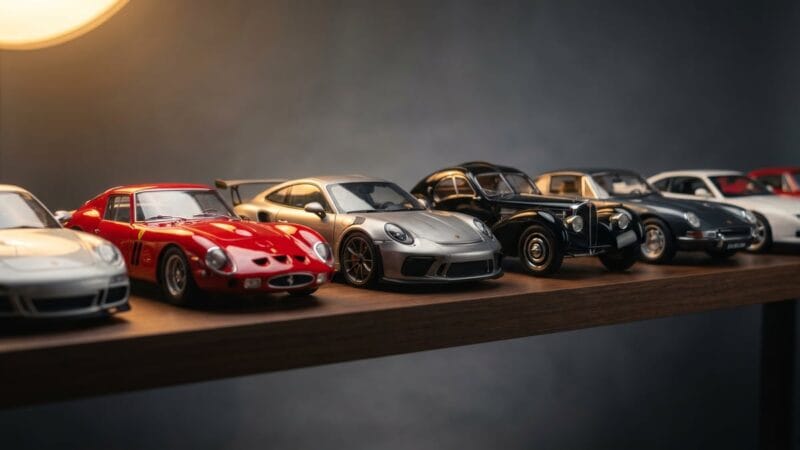
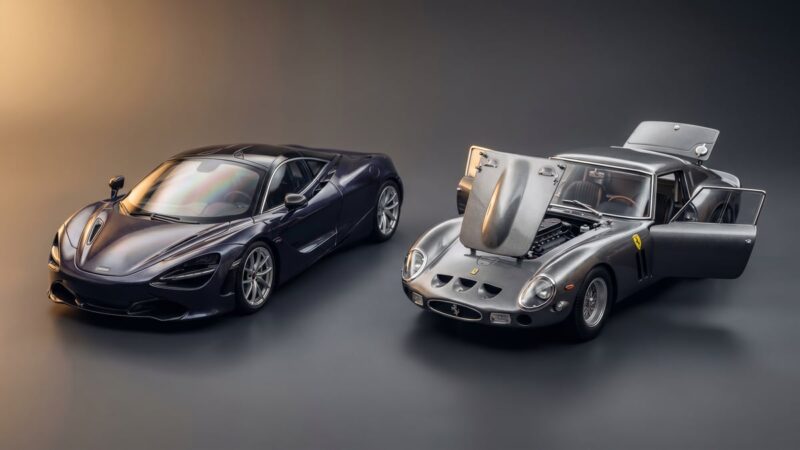
The third cost is detail you can actually see. Minichamps 1:43 models carry separately molded door handles, air vents, lamp lenses and hood badges — each a separately tooled, separately fitted part rather than a printed shortcut. At 1:18 the same approach gives crisp panel lines and fine trim. Because die-casting reproduces those surfaces with very good finish and dimensional consistency, the detail is repeatable across the edition rather than a lucky one-off.
This is the heart of the question “is Minichamps a good brand?” For collectors who value licensed accuracy and fine detail in racing and road cars, the quality is exactly what the premium buys. If you mainly want a lot of cars on the shelf for the lowest outlay, that same detail is money spent on something you may not prioritise — which is where the cheaper alternatives below come in.
Cost driver 4: limited, numbered runs and racing liveries
The fourth cost is scarcity built in by design. A “limited edition” simply means an edition restricted in the number of copies produced, and the binding constraint is the run size, not the word on the box. Minichamps spreads production across several hundred racing liveries on a base of well over a hundred different castings, so each livery is effectively its own small numbered edition rather than one enormous run.
Small runs cost more per model — fixed tooling and setup are divided among fewer units — and they also feed collector demand. From the early 1990s collectors began recording miniature variations much like stamp or coin collectors, which raised values for rarer references and pushed manufacturers toward exclusive limited editions aimed at a higher-price segment. Scarcity, in other words, is both a cost and a feature.
Are Minichamps worth the money?
Minichamps are worth the money when you want licensed accuracy and finely detailed models, and less so when your main goal is breadth on a tight budget. Because a licensed model’s desirability tracks the popularity of the real car, a well-chosen Minichamps tends to hold interest long after you buy it.
Do they hold their value?
They can. Value rises as surviving examples become rarer through loss and damage, and early small-run pieces can command premiums. But the honest caveats are real: limited liquidity, insurance cost and fraud risk, plus the rule that unless a piece is genuinely scarce, collectables rarely prove a spectacular investment. The sound default is to collect for enjoyment first and treat resale as a bonus. Either way condition drives value, and keeping the original box and inner packaging is agreed best practice for protecting a model in transport and storage.
| Cost factor | Minichamps | Value-tier diecast (IXO, Norev) |
|---|---|---|
| Car brand licence | Officially licensed by major brands | Licensed models available |
| Tooling and detail | Many separately tooled, fine parts | Strong detail for the price |
| Production approach | Small, numbered, many liveries | More budget-friendly to collect |
| Best for | Licensed accuracy, F1 and road detail | Building breadth on a budget |
If a particular subject matters to you, it is worth comparing like for like. You can see current Minichamps models and prices, read how Minichamps value compares against AUTOart, or step back and see how Minichamps ranks among model car brands.
Cheaper alternatives — and the Spark question
If you want the Minichamps look for less, value-tier diecast manufacturers such as IXO and Norev are stocked alternatives in our catalogue. Collector forums consistently reframe the “best brand” question as a material-and-preference choice rather than one ranking: openable diecast such as Minichamps, Norev, Kyosho and the AUTOart class versus sealed resin such as GT Spirit and the OttOmobile class. So the right answer depends partly on whether you want opening doors and panels or a sealed display finish. In practice that is a real fork in the hobby — opening doors and panels on a diecast versus a sealed display finish on resin — and it is worth deciding which you prefer before you judge any model’s price.
Is Spark better than Minichamps?
Spark is a separate model manufacturer under the Minimax group, and it is frequently raised as a Minichamps alternative in 1:43 Formula 1 — but it sits outside our assortment. That means the practical, in-store value comparison runs between Minichamps and the diecast manufacturers we actually carry, such as IXO and Norev, or against a resin rival, which you can weigh in our Minichamps pricing next to a resin rival comparison. For the wider picture of where every brand sits, see how Minichamps ranks among model car brands.