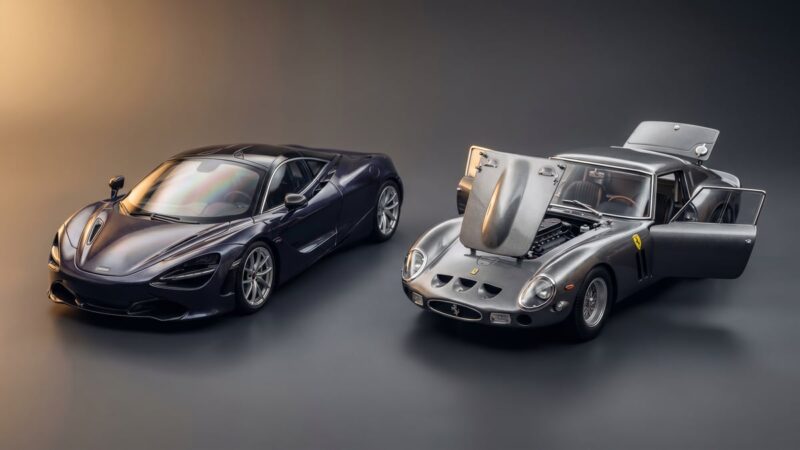
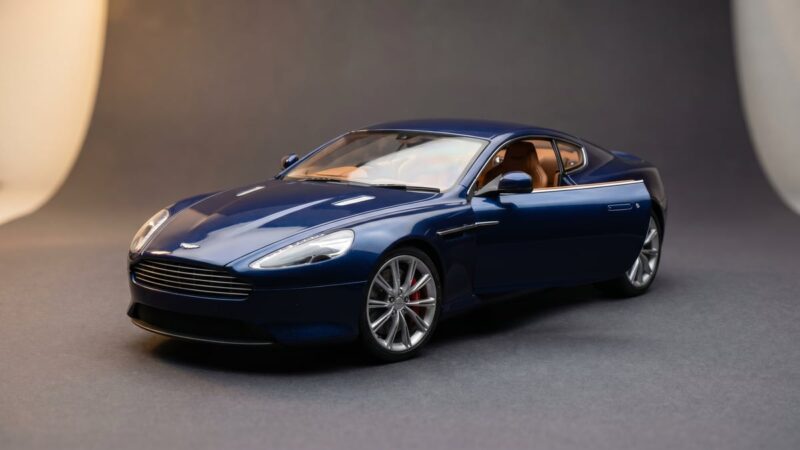
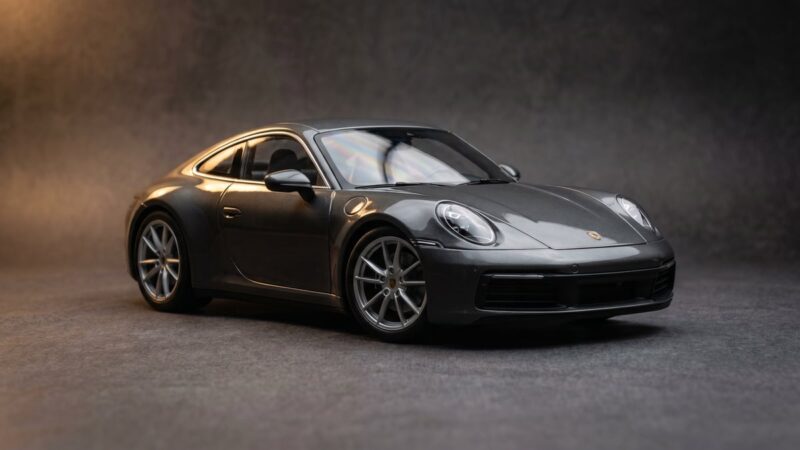
The model car brands worth knowing first are Minichamps, GT Spirit, OttOmobile, Norev and IXO — the five best-represented model manufacturers in our range, and a complete starting map for a 1:18 or 1:43 collection. The quickest way to choose between them is not a marketing tier but three plain questions: what material the brand works in, what price level that material implies, and how available and collectible its models stay.
Material is the master key. Diecast brands cast a zamak metal body, usually with opening doors, hood and trunk; sealed-resin brands hand-finish a one-piece body in small, numbered runs, which makes them distinctly pricier in the same scale; composite is a separate third family. One distinction matters before any of this: the car brand — Porsche, BMW, Mercedes-Benz — is the real vehicle, while the model manufacturer — Minichamps, Norev — is the company that licenses and reproduces it in scale. This guide profiles all five brands, shows how material sets price, matches each brand to the scale it owns, and explains which mechanisms make some models hold their value.
Which model car brands are worth knowing
If you are building a collection from scratch, five model manufacturers cover almost all of the ground: Minichamps, GT Spirit, OttOmobile, Norev and IXO. They are the most numerously represented manufacturers in our range, so availability is rarely the thing that holds a collection back. Rather than ranking them on prestige, it is far more useful to compare them on the differentiators that actually decide fit: the material each brand works in, whether its runs are numbered and limited or open-ended, and the official licensing behind a model.
- Minichamps — the licensed diecast benchmark, deepest in 1:43 and strong in 1:18.
- GT Spirit — the French sealed-resin specialist built around 1:18.
- OttOmobile — hand-finished, numbered resin in 1:18 and 1:12.
- Norev — value diecast with deep French heritage across many scales.
- IXO — the accessible entry tier, casting both diecast and resin.
Treat that shortlist as a map rather than a ranking: the best brand for you is the one whose material and price tier match how you want to display and grow a collection. You can browse Minichamps diecast models in our range or discover IXO entry-tier models to see where each brand sits before committing.
Car brand vs model manufacturer: the distinction that trips up new collectors
The car brand is the manufacturer of the real vehicle — Porsche, BMW, Mercedes-Benz — while the model car brand is the company that cast the miniature, such as Minichamps or Norev. Both names appear on the box, and confusing them is the most common beginner mistake. What connects the two is licensing: model manufacturers hold formal licensing arrangements with car brands to reproduce their vehicles in scale, an arrangement that became standard across the industry after the 1980s, whereas in the 1950s and 1960s models were often produced without any agreement.
That licensing is also a quality signal. Real car brands including Mercedes-Benz, Audi, Porsche, Volkswagen, Opel and BMW have licensed Minichamps to produce official scale models, which is one reason its detailing is held up as a reference point. When you read a brand name and a car name together, keep them in separate columns in your head: one is the company that made the car, the other is the company that made the model.
How material sets a brand apart: diecast, sealed resin and composite
Material is the single most useful way to sort model car brands, because it decides construction, opening features and price in one go. Collector model cars fall into three construction families, and a brand usually lives in one of them.
What diecast and zamak mean
Diecast brands cast the body from zamak, a zinc alloy, in hardened steel dies. That metal body gives the characteristic heft and, in most diecast models, opening doors, hood and trunk. The economics matter: steel die-casting tools cost a great deal and take months to make, which pushes diecast toward larger production runs and, in turn, more accessible prices. Minichamps, Norev and IXO all build their core lines this way. You can shop Norev value diecast models to see the everyday end of the material.
Why sealed resin costs more
Sealed-resin brands pour synthetic resin into flexible silicone moulds, then assemble and paint each body by hand. Those moulds are cheap but wear out after a limited number of castings, which is exactly why resin lines come in small, numbered editions and tend to be distinctly pricier than diecast in the same scale. The trade-off on the model itself is opening parts: a sealed-resin body is one piece, with the cabin visible only through the glazing. One myth worth retiring is that resin always means light — a sealed-resin model can be ballasted so that it feels every bit as hefty as a diecast.
Where composite fits
Composite is a distinct third category, not a flavour of diecast: it combines ABS plastic with diecast elements. The brand to know here is AUTOart, which switched from diecast to composite construction, so its older releases are diecast and its newer ones composite — a difference worth checking before you buy a specific car. For a deeper look at the materials side by side, read how diecast and resin model cars differ.
| Material family | Body | Opening parts | Typical run size | Price tendency | Example brands |
|---|---|---|---|---|---|
| Diecast | Cast zamak metal | Doors, hood, trunk usually open | Larger | Lower in scale | Minichamps, Norev, IXO |
| Sealed resin | One-piece cast resin | None (glazing only) | Small, numbered | Higher in scale | GT Spirit, OttOmobile |
| Composite | ABS plastic with diecast | Often open | Varies | Premium | AUTOart (newer era) |
If you want the licensed-diecast end of that table in front of you, browse Minichamps diecast models in our range.
The five brands, profiled
Here is what each of the five brands actually is, in one place. Minichamps is the German licensed-diecast benchmark; GT Spirit and OttOmobile are the French sealed-resin flagships from the same group; Norev is the value diecast brand with the deepest heritage; IXO is the accessible entry tier that casts in both materials.
Minichamps
Minichamps is the brand of the German company Paul’s Model Art, founded in 1990 in Aachen and officially named Minichamps in 1996. Its core production is diecast zamak across 1:18, 1:43 and 1:64, spanning Formula One, other racing cars and road cars. It is best known for exceptional 1:43 detailing — separately moulded door handles, air vents, lamp lenses and hood badges — and it is the most numerously represented manufacturer in our range. See where it sits against a composite rival in Minichamps and AUTOart compared head-to-head.
GT Spirit
GT Spirit is a French 1:18 specialist and one of the two flagship brands of Z Models, the same group behind OttOmobile. It produces sealed-resin models with no opening parts, and its calling card is paintwork: collector press singles out deep, metallic paint as the first thing that commands attention on a GT Spirit model. If sealed resin appeals, see GT Spirit sealed-resin 1:18 models, or read the resin-versus-diecast match-up in sealed resin versus detailed diecast flagships.
OttOmobile
OttOmobile — usually shortened to Otto — is a Breton brand developed in Josselin, France, producing resin models assembled and painted by hand in limited, numbered editions across 1:18 and 1:12. It runs member-exclusive Club OttO series alongside its general collection. OttOmobile and GT Spirit belong to the same group, Z Models, which also manages the budget diecast brand Solido — the same people run a resin house and a diecast house as separate material universes. You can explore OttOmobile hand-finished resin models to see the numbered end of the hobby.
Norev
Norev is a French manufacturer founded by the Veron brothers in Villeurbanne, near Lyon, in 1946; the name is simply Veron spelled backwards. Its core collector lines are diecast zamak — the famous Jet-Car series followed in 1971 — while some heritage and toy lines remain plastic, so it pays to check the material on an individual release. Its official catalogue spans scales from 1/12 through 1/18, 1/43 and 1/64 down to 1/87, which makes it a strong-value brand with unusual breadth. For a fuller verdict, read whether is Norev worth collecting — full review, or shop Norev value diecast models directly.
IXO
IXO documents every model it has produced since 1999 and manufactures both diecast and resin: diecast bodies are injection-cast in steel tools from molten zamak, while resin bodies are cast with hand-made forms. Each model consists of more than fifty parts, most of them hand painted, which suits an accessible entry tier and the large promotional series IXO produces for car brands. It is the natural place to start if you want collector-grade detail without the premium price. Begin with our IXO entry-tier models.
| Brand | Country | Core material | Scale focus | Position |
|---|---|---|---|---|
| Minichamps | Germany | Diecast zamak | 1:43 and 1:18 | Licensed diecast benchmark |
| GT Spirit | France | Sealed resin | 1:18 | Resin flagship |
| OttOmobile | France | Sealed resin | 1:18 and 1:12 | Hand-finished, numbered |
| Norev | France | Diecast zamak and plastic | 1:12 to 1:87 | Value, deep heritage |
| IXO | Macau-based | Diecast and resin | 1:43 and 1:18 | Accessible entry tier |
Which brand for which scale
Match a brand to your preferred scale as deliberately as you match its material. 1:18 is the flagship display scale, prized for the combination of size and detail — many 1:18 cars are over 11 inches, around 28 cm, long, with room for intricate detail and moving parts that smaller scales cannot carry. It is where GT Spirit, OttOmobile and Norev concentrate, and where Minichamps brings licensed diecast detail. 1:43 is the traditional European collection scale, with models 10 to 13 cm long; it is the most collected size in Britain, Europe, Japan and Australia, and the scale where Minichamps built its motorsport reputation. OttOmobile and Norev also run dedicated 1:12 lines for collectors who want large-format presence.
| Scale | Character | Brands that concentrate here |
|---|---|---|
| 1:18 | Flagship display scale, around 28 cm, opening parts common in diecast | GT Spirit, OttOmobile, Norev, Minichamps |
| 1:43 | European collection scale, 10 to 13 cm | Minichamps, IXO |
| 1:12 | Large-format premium, niche | OttOmobile, Norev |
Resale value and limited editions: what actually holds
Resale value comes from mechanisms, not forecasts, and three of them are worth knowing. First, a limited edition is an edition restricted in the number of copies produced; when a producer publishes a finite run size — Norev’s official store lists 1:18 editions of 200 pieces, for example — a sold-out reference becomes a permanent state rather than a temporary stock-out. Second, surviving examples grow rarer over time through loss and damage, and early production versions made before a model became popular can command premiums. Third, a model’s desirability tracks the popularity of the real car brand it replicates, so a licensed, sought-after subject in a numbered run is the combination most likely to hold value.
This is also why pre-order, limited and used describe distinct points in a model’s life. A pre-order reserves a unit at release and lets the manufacturer size the initial run to demand; a limited edition fixes the supply; and a used model is one that has already moved to the secondary market. To spot a limited run worth buying, confirm the manufacturer publishes a finite edition size and number, check that the subject is a popular licensed car, and treat a genuine sold-out edition as final. Sealed-resin brands such as GT Spirit sit naturally in this category, and you can read what drives premium pricing in what drives Minichamps pricing.
Frequently asked questions
What are good model car brands?
For 1:18 and 1:43 collecting the core brands are Minichamps, GT Spirit, OttOmobile, Norev and IXO. Each is defined by a distinct material and price tier rather than reputation alone, so the right one depends on whether you want licensed diecast detail, sealed-resin finish or accessible value.
What is the best brand for model cars?
There is no single best brand. Minichamps leads licensed diecast detail, GT Spirit and OttOmobile specialise in sealed resin, Norev offers strong value and IXO covers the entry tier — the best choice follows your scale, budget and whether you want opening parts.
What company makes model cars?
Model cars are made by specialist model manufacturers such as Minichamps, GT Spirit, OttOmobile, Norev and IXO, not by the car brands themselves. These companies hold licences from car brands like Mercedes-Benz, Audi, Porsche and BMW to reproduce their vehicles in scale.
Is diecast or resin better for a collection?
Neither is strictly better. Diecast gives a metal body and usually opening doors, hood and trunk and stands up to handling; sealed resin gives a finer one-piece cast and sharper paint but no opening parts. Choose by whether you value opening features or pure display detail.
Why are resin model cars more expensive?
Sealed-resin lines are hand-assembled in small, numbered runs using moulds that wear out quickly, while diecast uses durable steel tools built for high volume. That production economics, not prestige alone, is why resin tends to cost more in the same scale.
Which model car brand should a beginner start with on a budget?
IXO and Norev are the most budget-friendly starting points: IXO covers an accessible entry tier in both diecast and resin, while Norev offers strong-value diecast. Minichamps, GT Spirit and OttOmobile sit higher up for licensed detail or sealed-resin finish.
Which model car brand is best for 1:18?
For 1:18, GT Spirit and OttOmobile lead on sealed resin, Norev offers value diecast and Minichamps brings licensed diecast detail. The scale is the flagship display size, so most collector brands compete here.
Which model car brands hold their value?
Brands that publish finite, numbered run sizes — such as sealed-resin GT Spirit and OttOmobile, or Norev’s limited 1:18 editions — tend to hold value best, because a sold-out reference cannot be reprinted and surviving examples grow scarcer over time.
How do you spot a limited model run worth buying?
Check whether the manufacturer publishes a finite edition size and number, confirm the subject is a popular licensed car, and treat a genuine sold-out limited edition as permanent rather than a temporary stock-out. Pre-orders let you reserve a unit at release before that happens.